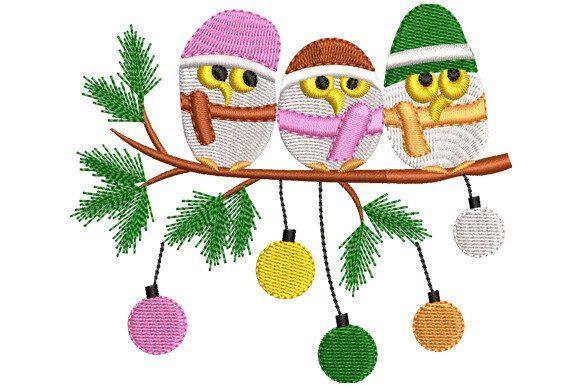
Christmas Owls on Christmas Branch
As an embroidery designer who spends weekends hunched over a table at craft fairs, I have learned that the difference between a design that sits untouched and one that sells out by noon often comes down to three things: visual impact, product suitability, and production efficiency. When I first reviewed the Christmas Owls on Christmas Branch embroidery design, my immediate reaction was one of cautious optimism. The concept is undeniably festive and whimsical, tapping into two perennial favorites: owls and holiday greenery. However, for a busy entrepreneur or Etsy seller, "cute" is not enough. It needs to be viable.
This review breaks down exactly how this design performs in a real-world commercial setting, from the initial booth display to the final stitch-out. We are looking at this through the lens of a professional who needs to produce consistent, high-quality goods without burning out.
First Impressions and Visual Appeal
The title Christmas Owls on Christmas Branch suggests a rustic, perhaps slightly farmhouse aesthetic. In the world of handmade products, this style has massive appeal because it feels warm and inviting rather than overly commercial or shiny. When you look at the digital preview, the design likely balances negative space with decorative elements, which is crucial for readability. At a crowded craft fair, customers scan displays from a distance. A design that is too cluttered gets lost; one that is too minimal might feel sparse. This design strikes a balance that works well as a focal point.
The mood is soft yet festive. It avoids the loud, neon-heavy vibe of some mass-produced holiday items, positioning itself instead as a premium, thoughtful gift. For boutique makers and creative entrepreneurs, this distinction is vital. You are selling the feeling of a cozy winter evening, not just a piece of fabric. The owl motif adds a touch of character that resonates with buyers looking for unique, handcrafted charm.
Product Suitability and Market Performance
Not every embroidery file translates equally well across different mediums. Here is how Christmas Owls on Christmas Branch performs on specific craft fair staples:
- Tote Bags and Market Bags: This is arguably the strongest use case. A canvas tote bag provides a large, flat surface that allows the branch details to shine. The natural texture of cotton or jute complements the rustic theme perfectly. As a tote bag design, it serves as both utility and decoration, increasing its perceived value.
- Apron Embroidery: Placing this design on the bib or pocket of a kitchen apron is a smart move. Aprons are high-impulse buys during the holiday season. The design’s horizontal orientation likely fits well across the chest area, creating a balanced look that doesn’t overwhelm the garment.
- Tea Towel Embroidery: Linen or cotton tea towels are classic market items. The design’s color palette—likely greens, reds, and whites—will pop against neutral backgrounds. It photographs beautifully for online listings, making it a strong candidate for printable mockups to attract remote buyers.
- Embroidered Patches: If the design includes a clean edge or can be easily hooped, it works exceptionally well as a sew-on patch. Customers love adding personality to their backpacks or jackets. This expands your reach beyond home decor into fashion accessories.
- Caps and Headwear: Curved surfaces present challenges. While possible, ensure the design is scaled appropriately so it doesn’t distort on the front panel of a baseball cap. It may work better on beanies or structured caps where the fabric is tauter.
- Pillow Covers and Small Pouches: These items allow for a more intimate presentation of the design. A small pouch makes for a perfect stocking stuffer, while a pillow cover offers a larger canvas for detail. Both are excellent small shop product ideas that command a good price point.
Production Practicality and Batch Efficiency
For any Etsy seller or digital embroidery file creator, time is money. The description mentions transforming creations with "just a few simple stitches," which implies a relatively efficient digitization. However, we must remain critical. Does the design rely on dense satin stitches that take forever to run? Or does it use lighter fill stitches that speed up production?
If the design is optimized for speed, it becomes highly repeatable for batch production. Imagine running ten identical designs in a row on a multi-head machine or quickly swapping hoops on a single-needle home machine. This efficiency allows you to meet demand during the peak holiday rush without sacrificing quality. The design should also photograph well under various lighting conditions, ensuring your online store images look as good as the physical product.
Careful-Use Notes and Technical Considerations
Before committing to mass production, there are several technical pitfalls to avoid. Even a beautiful design can fail if the execution is poor.
- Stitch Density: Check the stitch density carefully. If the owl’s eyes or the branch leaves are too densely packed, the fabric may pucker or the needle may break. Conversely, if it is too sparse, it will look thin and cheap on textured fabrics like towel loops.
- Fabric Texture: Remember that fabric texture affects clarity. On a rough burlap tote, fine details might get lost. Always test on the actual material you plan to sell. Smooth cottons and linens will render the design most accurately.
- Thread Contrast: Ensure there is sufficient contrast between the thread colors and the base fabric. Dark threads on dark fabric will disappear, ruining the visual impact. Light threads on white fabric can also lack definition unless they are thick or glossy.
- Hoop Size Constraints: Verify the recommended hoop size. If the design is larger than standard hoops, you may need to rehoop multiple times, which increases labor and the risk of misalignment. A design that fits comfortably in a 5x7 or 6x10 hoop is ideal for small business owners.
- Stabilizer Selection: Use the right stabilizer. Cut-away stabilizers are generally safer for stretchy fabrics or heavy items like tote bags to prevent distortion over time. Tear-away stabilizers work well for lightweight woven fabrics but may leave residue.
Strategic Advice for Sellers
To maximize the success of Christmas Owls on Christmas Branch, I recommend a phased approach. First, create at least one real mockup using your intended materials. Inspect the finished product closely. Are there loose threads? Is the placement centered? Does it feel premium?
Next, focus on your branding consistency. If your shop specializes in rustic, handmade gifts, this design aligns perfectly. It reinforces your brand identity as a provider of cozy, festive items. Use this design to create a cohesive collection—perhaps matching a tea towel with a matching coaster set or a tote bag with a small pouch.
Finally, do not forget the legalities. Confirm commercial licensing before selling finished products. Even if you are buying the embroidery file for personal use, selling the resulting goods requires proper permission. Protect your business by ensuring you have the rights to profit from this design.
In conclusion, Christmas Owls on Christmas Branch holds significant potential for craft fair sellers and online artisans. Its charming aesthetic, combined with practical versatility across various textile products, makes it a strong contender for holiday inventory. By paying attention to technical details like stitch density, fabric choice, and stabilization, you can turn this design into a best-selling item that delights customers and boosts your bottom line. Test thoroughly, produce efficiently, and let the craftsmanship speak for itself.